
The lowdown on the ten most important Greek cities in the ancient world, their statuses today, and what remains of their archealogical wonders
Antioch

Antioch may have been a small Greek trading colony before Seleucus I Nicator founded the city shortly after 300 BC. Seleucus was a general of Alexander the Great’s – the Macedonian who conquered half the known ancient world and beyond, before his untimely death at 32. Seleucus, inspired by his mentor, forged his own empire – the Seleucid Empire – and made Antioch its capital and one of the greatest of the Greek cities before Rome took control in 64 BC. Antioch was laid out in imitation of Alexandria by the architect Xenarius, and included two great colonnaded streets intersecting in the centre. It attracted 25,000 Greek settlers, including Alexandros of Antioch – sculptor of the famous Venus de Milo statue.
None of Antioch’s Greek architecture remains; indeed, it was renamed Antakya by the Ottoman Empire now in modern-day Turkey. With a population of 400,000 people, it’s a provincial capital of considerable importance like its predecessor.
Argos

Argos isn’t just the oldest of the ancient Greek cities, it’s the oldest city in Europe, being settled as far back as 8000 BC. It was said by Herodotus that the ancient Macedonian royal house of the Argead dynasty originated from the city and its timeline is littered with a multitude of great figures from ancient Greek mythology. Argos sat at a strategic location on the fertile plain of Argolis, and grew into a major stronghold. In classical times, Argos was a powerful rival of Sparta for dominance over the Peloponnese, but was eventually shunned by other Greek city-states after remaining neutral during the Greco-Persian Wars.
Modern Argos is a modest city of less than 30,000 – smaller than its 4th Century population. It is situated in the Argolis region and prized for its citrus fruit and melon farms. Its ancient theatre and the bouleuterion (senate house) still survive, so too does the “Criterion” of Argos – an ancient monument on the city’s south side.
Athens
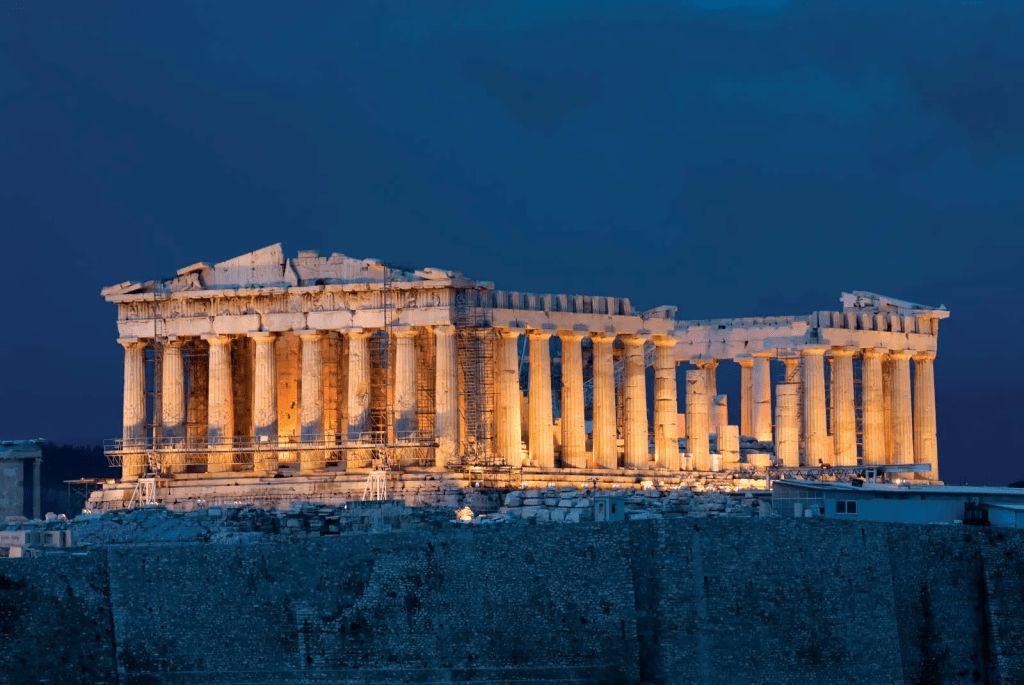
The greatest of the Greek city-states, Athens’ status as the epicentre of Greek civilisation goes back to the Bronze Age, being advantageously situated, as it was, on central mainland Greece whilst having access to the sea. By 1000 BC, Athens had fused surrounding settlements into an unusually large city-state. Yet with the coming together of so many urbanites, civil strife festered until the city’s leaders enacted draconian laws, a constitution, and the world’s first democracy in the 6th Century to become the cradle of Western civilisation. The rest, as they say, is history. Athens dominated the Hellenistic world with a vast navy in the 5th Century and so many great people gushed from this well-spring of culture, including Pericles, Socrates, Plato and Aristotle. And it grew enormously with 10,000 houses equating to over 100,000 residents! Athens lost its independence to the Macedons then Romans by the 3rd Century BC.
Today, of course, Athens remains the most important city in Greece as the nation’s capital with over three million who call it home. It has a large financial sector and the 2nd busiest passenger port in Europe. The Parthenon is the most well known of Athens’ many ancient ruins. Visitors can also gawp at the Erechtheion within the Acropolis of Athens, the Temple of Hephaestus and the exhibits in the National Archaeological Museum.
Corinth

It wasn’t until the 8th Century BC that Corinth became established as a city and commercial lynchpin in Ancient Greece, situated, as it was, on the eponymous isthmus that links the Peloponnese with the rest of mainland Greece. Corinth was ruled at first by a Doric clan named the Bacchiadae who developed it into a highly advanced city with at least 5,000 citizens. A series of tyrants then ruled from the 7th Century, including Periander, one of the Seven Wise Men of Greece, growing Corinth’s wealth and power to the extent it founded colonies throughout the Mediterranean, including Syracuse (below). They launched the trireme warship design for the rest of classical Greece to adopt and began hosting the Isthmian Games from 581. They also gifted Greece the sophisticated Corinthian style of classical architecture, reflecting their wealth and haute couture. The Romans captured Corinth and brought the city to its knees in 146 BC.
Modern-day Corinth is located two miles (3 km) north west on the Corinthian gulf and astride its namesake ship canal. It’s home to almost 40,000 people and is an industrial hub with its own massive oil refinery. What ruins of the ancient city that survived the 1858 earthquake remain, including the Temple of Apollo, the Acrocorinth Sanctuary of Demeter and Kore as well as the Peirene.
Delphi

The legendary heart and soul of the Ancient Greek world was Delphi; a sacred precinct and the seat of Pythia, the legendary oracle who was consulted about important decisions throughout the ancient classical world. Delphi was no mere epicentre of Ancient Greece, it was considered the literal centre of the world, marked by the stone monument known as the Omphalos of Delphi (navel). An important oracle was based there from as early as the 14th Century BC and became the lynchpin of Greek identity by the 5th Century. Then, it fell into decline after being raided and destroyed by a Thracian tribe in 278. Like Olympia (below), Delphi would’ve been full of temples, treasuries and other venerated structures in its heyday.
The denizens of Delphi were actually moved in the 19th Century AD to the modern town that adjoins the excavated ancient precinct. Situated in Central Greece, it is now a terraced tourist town of 25,000 people. Plenty of Delphi’s ancient Greek ruins can be found to look around, including the Temple of the Athenians, Temple of Apollo, Altar of the Chians, and Theatre of Delphi, to name a few.
Olympia

The original ‘Olympic village’ was established as a panhellenic religious sanctuary dedicated to Zeus around 1000 BC before the very first Olympic Games event was hosted in 776. With events such as running, combat sports, equestrian events and pentathlon, Olympia was packed with numerous arenas. This religious epicentre was also crammed with over a hundred temples, altars, statues and other structures dedicated to many deities in order to spiritually satiate the 50,000 Greeks who swelled Olympia’s population every quadrennium.
Olympia, a western Peloponnese town, has over 10,000 residents today in a region noted for its fine olive groves. Olympia’s archeology has been so well preserved that the ruins of dozens of Olympia’s 760 buildings still remain, such as the original Olympic Stadium, the Pelopion, Temple of Hera and Philippeion.
Pergamon

Established as far back as the late 8th Century BC, Pergamon became known for its great wealth and power across the Hellenistic world. It was first recorded by Xenophon as the city Cyrus the Younger ended his march around Asia Minor of the ‘Ten Thousand.’ Pergamon grew as a city state in the 3rd and 2nd centuries under the Attalid family who became firm allies of the Roman Empire as it wrestled for hegemony with Macedonia. At its apex, Pergamon covered 220 acres within 2.5 miles (4 km) of massive walls, vying with Athens for grandeur. Its library rivalled the Library of Alexandria as the greatest in the ancient world and it was noted for its excellent parchment. After Attalus III died without an heir in 133 BC, he bequeathed the whole of Pergamon to Rome.
Nowadays, the Turkish city of Bergama exists in Pergamon’s place, just south of the ancient city. It has a population of just over 100,000 people and is known for its cotton, gold, and fine carpets. Many of Pergamon’s architectural riches have been excavated, including the 10,000 seater theatre, Temples dedicated to Trajan, Hera and Athena, and the Asclepieion of Pergamon.
Sparta
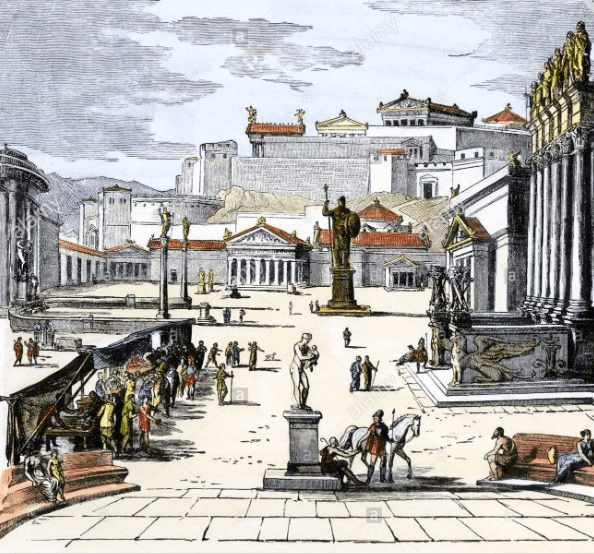
The city that gave us the word for a brutal lifestyle that promotes strength and resilience, was established on the fertile Evrotas Valley in 1000 BC. Yet it wasn’t until a wearisome period of lawlessness and civil strife racked Sparta that a legendary lawmaker named Lycurgus enacted a constitution, laws, and social reforms that transformed Sparta into a society where every facet revolved around creating elite fighting men to gain the city-state the glory and prizes of war. By 650 BC, Sparta’s reputation as a land-fighting force was unequalled. The 5th Century historian Thucydides wrote that the four villages that fused together did not form a grand city. He wrote: “The city is not built continuously, and has no splendid temples or other edifices…” Yet, Sparta did include the immense Tomb of Leonidas, a theatre, and large city walls. At its peak Sparta hosted up to 50,000 inhabitants. The city fell into decline after 371.
Nowadays just 32,000 call it home. It is the capital of the Lakonia prefecture, known for the finest olive oil in the world and is also the Peleponnese’s main hub of higher education. Ancient Sparta’s ruins lie just north of the city and include the South Gate of the Acropolis, the Sanctuary of Artemis Orthia as well as Leonidas’s tomb.
Syracuse

This city was founded in 733 BC by a Corinthian coloniser named Archias. Consulting an oracle at Delphi, Archias is said to have opted for wealth over health and so he established Syracuse, a city that rose to prominence as a powerful center of trade and Greek culture, and came to dominate Sicily. Its subsequent prosperity became so renowned that it gave rise to a proverb characterizing extravagance—’the tithe of the Syracusans would not be sufficient for them.’ Syracuse was declared by the Roman philosopher Cicero as his favourite and most beautiful Greek city. It was also the birthplace of mathematician Archimedes.
Today Syracuse is home to over 120,000 Sicilians and is the capital of the eponymous Italian province. The Temple of Apollo, Fountain of Arethusa and the vast Greek Theatre still stand. The city boasts a captivating blend of historical landmarks, cultural attractions, and natural beauty.
Thebes

Thebes was established as far back as the Bronze Age Mycenian era and was one of the first Greek communities to be drawn together within a fortified city, dubbed the ‘Seven-Gated Thebes’ by Homer in his epic 8th Century Iliad. Thebes thus thrived as an indefatigable buttress to the aggressive ambitions of Sparta, and Athens – its erstwhile enemy. This bitter civic blood-feud festered to such an extent that Thebes allied with all who sought to subjugate Athena, including the Persians and Spartans, developing Thebes into the predominant Greek city-state by the end of the 5th Century. With Athens hobbled, Thebes then grappled with the oppressive Spartans throughout the 4th Century before eventually falling to Alexander the Great who destroyed the city around 335 BC.
Today, the remains of Thebe’s formidable fortress remain, and much else of the city’s ancient Greek past is on display at the Archaeological Museum of Thebes – Greece’s finest museum. 32,000 Thebans inhabit the bustling market town.
 History and Things
Leave a comment