
Click for Part 1
Battles of Saratoga, 1777

Almost two years into the counter insurgency campaign to end the American Revolution, British General John Burgoyne set off from Quebec with mixture of 7,200 loyalist Americans and Germanic troops to meet two other armies with the aim of cutting off the particularly insurgent New England region from the rest of the colonies. At this point in the revolutionary struggle, the Americans dominated the colony’s transport and supply network. So every day that the British forces remained in the field they weakened, and every day the Americans remained mobilised they grew in strength.
After a defeat at Bennington in August, Burgoyne’s Indian allies abandoned him. Without guides and diminishing supplies, his command tentatively reached Saratoga where the first of two battles were fought in mid-Autumn. In the first, the British suffered high casualties among their officers as marksmen picked them off. They strained and finally forced the Americans to retire from the battlefield by the day’s end. Surrounded by ever increasing numbers of rebels, Borgoyne was forced to fight again. In the 2nd battle, the Americans withstood an assault by grenadiers but Brigadier-General Fraser then fell, mortally wounded. With more Americans joining the fray Borgoyne was forced to retreat under hot pursuit to a redoubt before nightfall. This saved Borgoyne’s command from destruction, giving him time to negotiate a humbling submission.
The British suffered a thousand casualties in the two battles and the 6,000-odd remaining troops were taken into captivity. This major British failure marked a turning point in the war as it secured the active involvement of the French. Their military support to the fledgling US republic would ensure the loss of Britain’s Thirteen Colonies and the end of the ‘First British Empire’.
Siege of Yorktown, 1781

The result of France’s support for the US fight for independence bore fruit in July, 1781. Events had transpired that an army of 9,000 British, headed by Lord Cornwallis had allowed itself to be corralled into Yorktown, Virginia where they then awaited reinforcements from the sea. US General Washington, meanwhile, had concentrated a 7,000-strong army of Americans and French near New York city. Washington had wanted to campaign around New York, but it was decided French naval forces in the theatre could be better used to blockade the British in Yorktown instead. Washington complied and marched south to Yorktown, arriving by September’s end. Now, Cornwallis was trapped.
A British fleet attempted to break the blockade and provide reinforcements but were fought off by the French fleet at the Battle of Chesapeake. From now, Cornwallis would have to try to fend off the encroaching Allied army alone, although Yorktown’s defences were formidable, with hundreds of cannon and a number of redoubts. Early attempts to storm the redoubts failed, yet the redcoats noted with alacrity a trench parallel to their main defences soon appeared. The Allies utilised this trench to position cannon within range of the main British fortifications. From there the siege advanced. The beleaguered redcoats were pummelled into submission. Landward cannon smashed Yorktown’s streets and defences alike, whilst the French fleet sank ships in harbour. Finally Cornwallis accepted the writing on the wall, surrendered and 7,500 of his men were taken into captivity.
The wider implications of this defeat were devastating for the Crown; the fall of Yorktown sealed the loss of the ‘Thirteen American Colonies.’
Battle of Castlebar, 1798

One late Summer in County Mayo, Ireland, the British suffered what was said to be the most humiliating defeat in their history up until that point. The Irish were fighting their own independence war. There were some familiar actors too; Lord Cornwallis was military commander in Ireland and the French were again on the scene, trying to serve liberté to another subjugated people of the British Crown. The Gauls were coming good on their promise to provide troops and naval support to the United Irishmen by landing over a thousand troops to be augmented by rebels. This force then set out to capture Castlebar. A British force thrice the size and with artillery, however, lay in wait.
The British force of regulars and local militias were caught akimbo when the Franco-Irish force of 2,000 managed to sneak up on them from an unexpected angle. Despite this, the British cannons cut swathes through the oncoming Franco-Irish. The attackers spotted a defile that would shelter them in their approach towards the artillery and, getting in close, launched a frenzied bayonet charge. The inexperienced infantry behind the cannons lost their nerve as the enemy neared, and once the enemy closed with them, panicked. The debacle of the ‘Castleford Races’ then proceeded. Thousands of British turned tail and fled from the battlefield in blind terror, tripping over each other to save their own skins. Tonnes of supplies and weapons were abandoned for the exultant Irish republicans and, to add insult to injury, some of the troops fighting on the side of the Brits even changed sides mid-battle and began attacking their own comrades-in-arms. In spite of this victory, the flame of rebellion was snuffed out by Autumn’s end
Walcheren Campaign, 1809

The British invasion of modern-day Netherlands during the Napoleonic Wars was aimed at capturing Walcheren island in order to deny use of the Scheldt estuary to a French invasion fleet. In mid-summer of 1809, 525 ships ferried 40,000 men across the English Channel in what was then Britain’s largest ever overseas expedition. The force landed well enough and soon captured the deep-sea port of Vlissingen whilst a polyglot cinderella force drawn from the French Empire struggled to obstruct the British in their quest to seize Antwerp. Perhaps those French troops would’ve performed better if they hadn’t suffered 80% casualties a few years prior from something that was already beginning to decimate the British. The local low-lying and swampy terrain was a breeding ground for mosquitos. The number of combat effectives amongst the redcoats plummeted as thousands fell lame to fever. Physicians within the British camp were quickly overwhelmed, despite the British high command having known what the dangers of ‘Walcheren Fever’ – a combination of malaria, typhus, and typhoid fever – were before the expedition’s go-ahead.
The five-month campaign unravelled as defending Napoleonic forces were reinforced and Antwerp put out of reach to the British. Remaining in the Netherlands was no longer justifiable, especially in the face of crippling casualties; combat effectives trickled to just 5,000 by September whilst 12,000 lay stricken. Another 4,000 had succumbed, including Lieutenant-General Alexander Fraser. The Royal Navy launched an evacuation and the Walcheren fiasco was over by Christmas. The Crown suffered acute political embarrassment as a whopping £8 million was wasted on the expedition. What is more, 12,000 much-needed frontline troops remained incapacitated for many months to come.
Battle of Grand Port, 1810
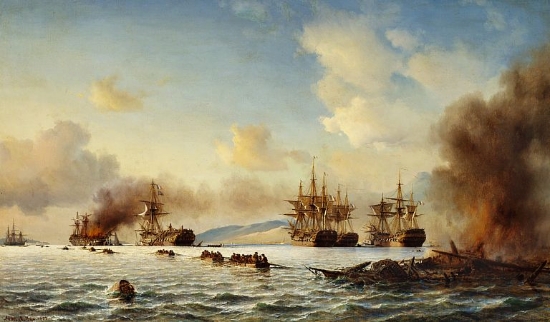
Throughout the Napoleonic Wars, Britain ruled the waves and triumphed against Napoleon’s fleets at every turn. The sole exception to this was when a squadron of its frigates was utterly destroyed by a weaker squadron of French around the waters of modern-day Mauritius.
The French had been using Isle de France as a base for its warships to maraud across the Indian Ocean and prey on British merchant ships. Considering this was the City of London‘s main revenue stream being disrupted here, capturing their bases of operation was quickly made a priority. Île Bonaparte (Reunion) was subsequently captured to be used to neutralise Isle de France and the French fleet operating from there.
First, the British tried to ambush the French fleet of three frigates, plus two captured merchant ships, returning to Grand Port but failed and the French ships reached harbour sanctuary. Royal Navy commander Samuel Pym thus sallied forth to attack the enemy where they anchored. But Grand Port entrance was extremely hazardous. A mass of jagged coral reef afforded just one way in – a narrow, treacherous channel. The battle, lasting over a week, went awry for the Brits within minutes when a frigate struck the reef and a second frigate soon joined it. For the French, the same reef that was shielding them immobilised them also. All their ships were beached leaving only one fifth-rate frigate to repulse their stricken adversaries. This frigate was well sighted, however and extra guns and crew were added by the resourceful French. The British struggled manfully to extricate themselves but two of their frigates could do nothing but surrender and Pym decided to scuttle his other two fifth-rates to deny them to the French. With supplies low, the ‘Jacks’ surrendered. The Royal Navy suffered a bloody nose with a total five ships lost and 250 casualties in Napoleon’s sole naval victory against Great Britain.
Battle of Nsamankow, 1824

Britain lost a colonial Governor in a calamitous battle in West Africa. Founded in the late 17th Century, the Ashanti Empire, in modern-day Ghana, was one of Africa’s most advanced polities and, with its formidable army, was pushing southwards towards the Gold Coast by the start of the 19th Century. On the coast, the Fante Confederacy ruled a patchwork of kingdoms and were clients of the British. Yet they were increasingly under the cosh in their struggle to resist their ever more aggresive northern neighbours. The Crown’s initial policy had been to tolerate Ashanti claims over the Gold Coast so long as a number of British forts could be maintained. This changed, however, when the territory was upgraded in 1821 from ‘client-kingdom’ status to Crown Colony status in an effort to stamp out the still-thriving slave trade there. With the Brits now firmly invested in the region, it was inevitable the two alpha empires would have a clash of arms to establish dominance before long – all that was needed was a spark. In 1823, a Royal African Corps soldier had gravely insulted an Ashanti trader so an Ashanti war party murdered him before ambushing a small British force.
Governor Charles MacCarthy ordered his army to march inland and neutralise this war party. His army totaled 1200 soldiers and militia augmented by over 11,000 Fante allies that were divided up into four battle-groups, yet MacCarthy joined the smallest of these; an advance guard of 500-odd soldiers and tribesmen, believing it was only the small warband his troops had to contend with. MacCarthy was wrong; the Ashanti king had mobilised his main army of 10,000 well-disciplined men armed with rifles – albeit with nails substituted for bullets. That army made its way through the thick jungle towards the Pra River – the border of their lands. On the 21st of January 1824, MacCarthy’s force awoke in their encampment on the river’s banks to see a large enemy army assembled on the other side. The river was 18m (60ft) wide at this point and, once fighting broke out, the British were at first able to shoot any enemy soldiers who attempted to cross the river across felled trees. Yet their ammunition soon ran low and what few supplies that could be rushed from the rear were opened to reveal some shot …and macaroni. Their position crumbled once their ammo ran out and the Ashanti could be held off no longer. As their Fante allies fled, the British troops were overwhelmed in hand-to-hand combat. Governor MacCarthy attempted to fall back but was wounded by gunfire and he killed himself rather than be taken prisoner. His gold-rimmed skull was later used as a drinking-cup by the Ashanti rulers.
What British troops that survived this opening encounter of the 1st Anglo-Ashanti War likely didn’t survive captivity for long. Some weeks later, a larger colonial force was also repulsed by the Ashanti army and withdrew, and the British were only saved from the enemy’s follow-up offensive along the coast by a wave of disease that decimated their ranks. The war – the first of five between the Ashanti and British – would end in a treaty that confirmed the Pra River as the border between the two adversaries.
Click for Part 3
Make a one-time donation
Make a monthly donation
Make a yearly donation
Choose an amount
Or enter a custom amount
Your contribution is appreciated.
Your contribution is appreciated.
Your contribution is appreciated.


No Battle of New Orleans War of 1812?
LikeLike
It’s a good shout, tbf. I will think about editing the article some time.
LikeLike