
Actually a rather nasty incident; when a landfill being used to build the Nice Airport collapsed, it triggered two large waves which delivered death and destruction to the French Riviera
The area around Nice in the South of France is the Mediterranean playground of celebrities, billionaires and European royalty, boasting miles of white-sand beaches, sparkling ocean and 300 days of sunshine a year. Yet, on October 16th, 1979 disaster struck this beautiful coastline.
Six kilometres from the city centre, the international Nice Côte d’Azur Airport was being expanded into a two-runway, three-terminal airport that would cover 3.70 km2 (1.43 sq mi) using mostly reclaimed land. Plus, a new municipal port was being added. At 2pm the reclaimed land for the harbour gave way, triggering a submarine landslide and tsunami. Seven workers were the initial fatalities in this ripple of disaster.
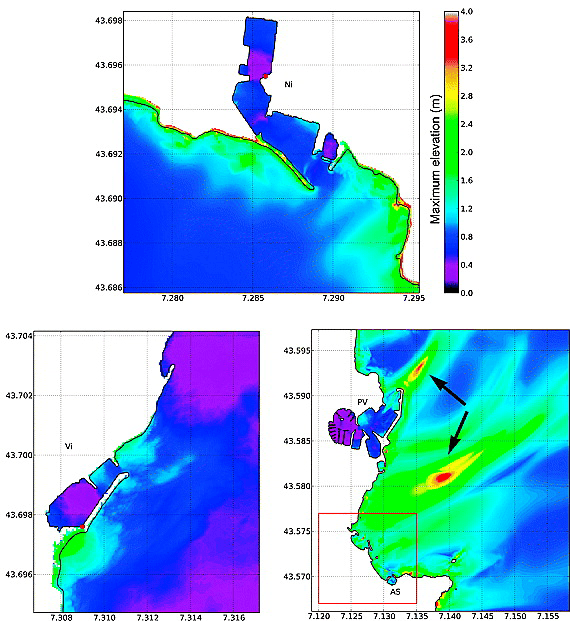
The coastline around the French Riviera is actually quite prone to natural landslides due to the numbers of canyons off the continental shelf. The Riviera town of Menton was hit by a tsunami during the 1887 Liguria Earthquake, for example. The collapse of so much of the harbour landfill triggered a much bigger landslide in one of the canyons below the airport. 10 million cubic metres in total shifted, launching a 2nd wall of water.
In Nice’s old port, the water level dropped by two metres as the two tsunamis emanated out from the airport to rampage along a 96 km (60 mile) stretch of coastline from nearby Antibes to the Italian border. Antibes’ neighbourhoods of La Salis and La Garoupe took the brunt of the tsunamis where they peaked at 3.5 metres (11.5 feet) high and crashed as far as 150 metres inland.
Between 8 – 23 people were swept away that day. Considerable economic damage was suffered as well. What’s more, the landslide travelled so far, two sea cables 80 and 110 km (50 and 68 miles) out to sea were snapped several hours later from the moving mass of mud, clay and rock.
As the underlying sediments below the harbour were obviously not stable, its construction was abandoned, although the airport expansion was completed. This unusual disaster seems little remembered otherwise.
 History and Things