Click for part 2
Battle of Togbao, 1899

In Central Africa, a punative field force was destroyed in circumstances the French would nonetheless take full advantage of. The long-standing Kanem–Bornu Empire, centred around Lake Chad, was well past its zenith by the turn of the century. It had never been conquored before the ruthless warlord Rabih az-Zubayr arrived and, with his slave armies and brutal methods of subjugation, conquored Kanem-Bornu as well as the vassel kingdom of Bagirmi by 1894. For the French, Rabir was merely another obstacle to be brushed aside in their ‘scramble for Africa’ and they were happy to sign a treaty of friendship in ’97 with the Bagirmi Sultan Gaourang II as a prelude to their own move on the region. With the treaty signed, naval Lieutenant Henri Bretonnet was ordered to lead 50 Senegalese troops plus three cannon to confront the Sudanese warlord. Yet, the Gauls seemingly underestimated Rabih in sending such a meagre force.
At Kouno in June 1899, Bretonnet joined up with Gaourang II who augmented Bretonnet’s force with 400 men of his own, but the French commander also got wind of the massive force Rabih was sending his way; 2700 rifle-armed infantry plus 10,000 auxilliary troops. Bretonnet realised he was staring into a hippo’s giant gaping mouth and scurried away to defend himself amidst the rocks of the nearby Togbao hills. On July 17th, Rabih attacked. Bretonnet’s men stood up to the first assault but the lieutenant was badly wounded and his artillery officer killed. The French resisted the next assault too but began to crack under the tremendous pressure they were subject to; Bagirmi soldiers began fleeing the battlefield. Rabih’s 3rd hammer blow then shattered his enemy and all but three of the French were slaughtered.
This defeat did not disturb the colonial administration unduly. It was just the strategic incentive they sought to despatch a proper military expedition into the region that would defeat and kill Rabih in the Battle of Kousséri. The colony of Chad was established later that year.
Madagascar Uprising, 1904
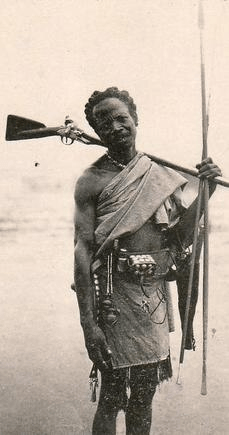
The 1885 Berlin Treaty divvied up almost all the remaining parts of Africa so far uncolonised, and France was alotted the island of Madagascar. France, in order to take over the island, followed the European imperialists playbook: Sign a treaty of ‘friendship’; establish a presence in the territory with trade stations and missionary work; use their presence to perceive wrongdoings in order to justify military intervention and subjugation. This was accomplished by 1895. As was common, the French did not endear themselves to their new subjects due to their heavy taxes, use of forced labour, general brutality and most importantly not employing the Malagasay ruling elite to more smoothly wield France’s dominion. The Menalamba Rebellion subsequently took two years to put down and the Malagasy were not finished. Seven years later the touchpaper of revolt was lit again…
French troops were thin on the ground in the south east to the extent that the post at Amparihy was merely held by Sergeant Vinay, with indigenous militiamen under his command. The Frenchman was on a visit to a nearby village when he was hacked to death in the night by Malagasy rebels. They now braced themselves for the French reaction. Lieutenant Baguet, commanding just 12 riflemen with 140 rounds between them, was despatched to Amparihy, believing Vinay’s death to be an isolated incident. Little did he know what was awaiting his troop; 80 rebels had sacked the post, burned half the town down, ransacked the armoury and now waited in deadly earnest. After a hard march on the 21st of November, Baguet arrived on the town’s outskirts and found he was unable to cross the Onilahy river to reach the military post. His position was now a vulnerable one, bottled up between the confluence of the Onilahy and another river, Baguet had just one escape route. The next day, the rebels forded the river upstream and attacked the troop of 12. Seriously outnumbered, Baguet’s position disintegrated into a rout, and he plus four others were killed.
French losses in the ‘Battle of Amparihy‘ were trifling, but that missed the point; the rebels had faced the French in combat and had triumphed. An uprising, led by two militia corporals – Kotavy and Tsimanindry – quickly spread. A group of French soldiers were massacred at Begogo and numerous towns were captured and looted. Kotavy was finally arrested in August 1905 which brought the uprising to an end. The French would go on to face another revolt in 1947 before the island nation achieved independence in 1960.
Battle of the Frontiers, 1914

It was during the early half of World War I that battlefields were at their most deadly before mobile armour was developed to counter the increasing mechanisation of firepower. As such, horrific numbers of exposed French soldiers had their lives snuffed out on the meat-grinder battlefields of northern France/Belgium, especially so in the first month.
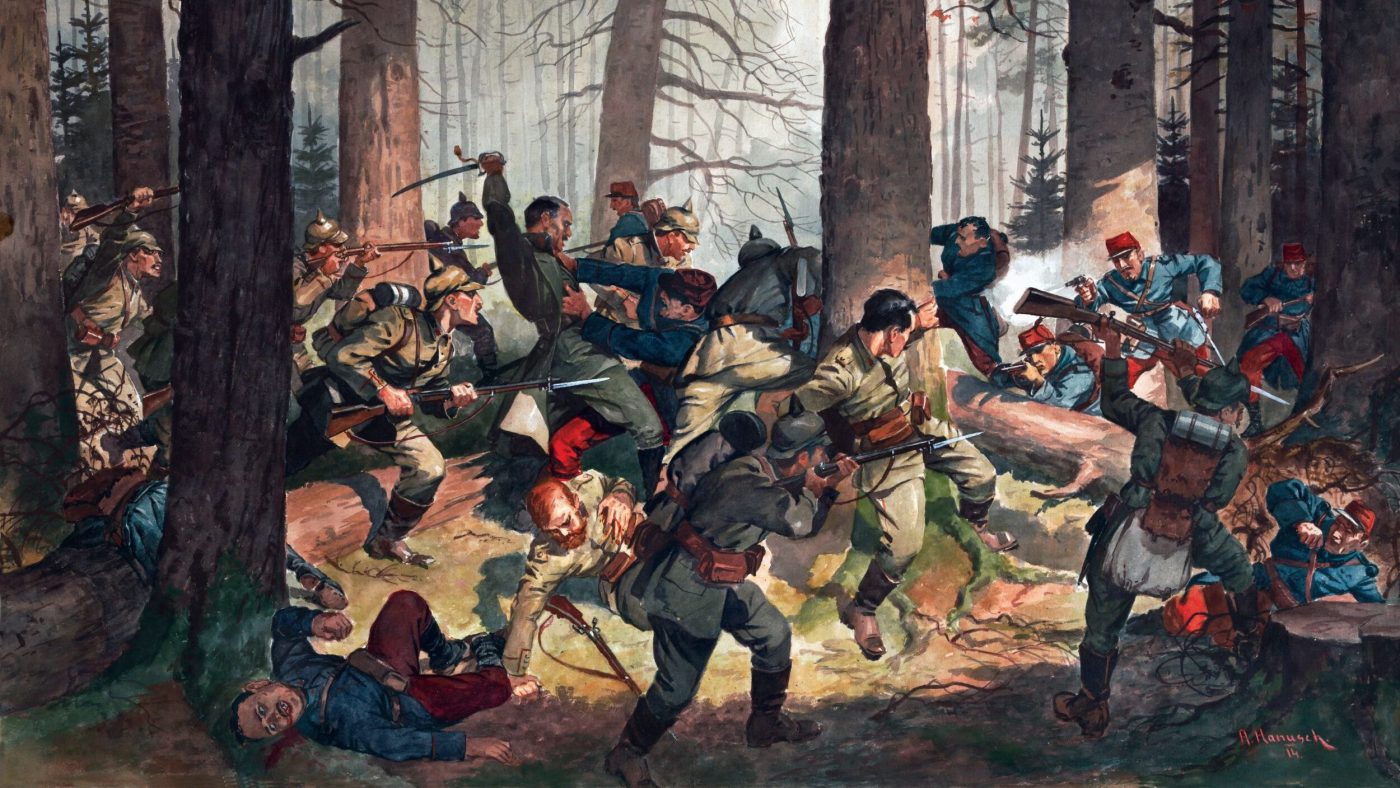
Prewar French and German army strategies broadly mirrored each other in that they involved massing the bulk of their massive armies on the borders to deliver shattering hammer blows to the enemy. 62 French divisions (plus 12 Belgian and British divisions) faced 68 German divisions and, on August 7th, Commander-in-Chief Marchal Joffre swung his sledgehammer first with an offensive into Alsace-Lorraine. Despite initial gains, the French offensive failed abysmally due to insufficient reconnaisance, a gung-ho attitude by their infantry and a lack of artillery-infantry co-operation. Plus the Germans wielded their armies and artillery with the deadly precision to revive painful memories of 1871. A jostling mass of French formations flung themselves at their foe but were flayed; the 26th Division of XIII Corps attacked Cirey on the 8th but was shredded in a maelstrom of artillery and machine-gun fire; on the 15th, German long-range artillery was able to bombard the French artillery and infantry undisturbed while dug-in German machine-gunners scythed through onrushing Gauls; on the 22nd, the French suffered 27,000 dead – the highest ever suffered in one day – the 3rd Colonial Division being destroyed as a fighting force, with casualties of over 10,000.
In less than one month, the French Army suffered 329,000 casualties in a stunning defeat. The Germans then delivered their own hammer blow, knocking the Allies back 120 miles (200 km) into France until they were finally checked at the 1st Battle of the Marne, just 30 miles (50 km) north east of Paris. After much exertion, the Allies would eventually force the ‘Boche’ to their knees in 1918.
Battle of Ouergha, 1925
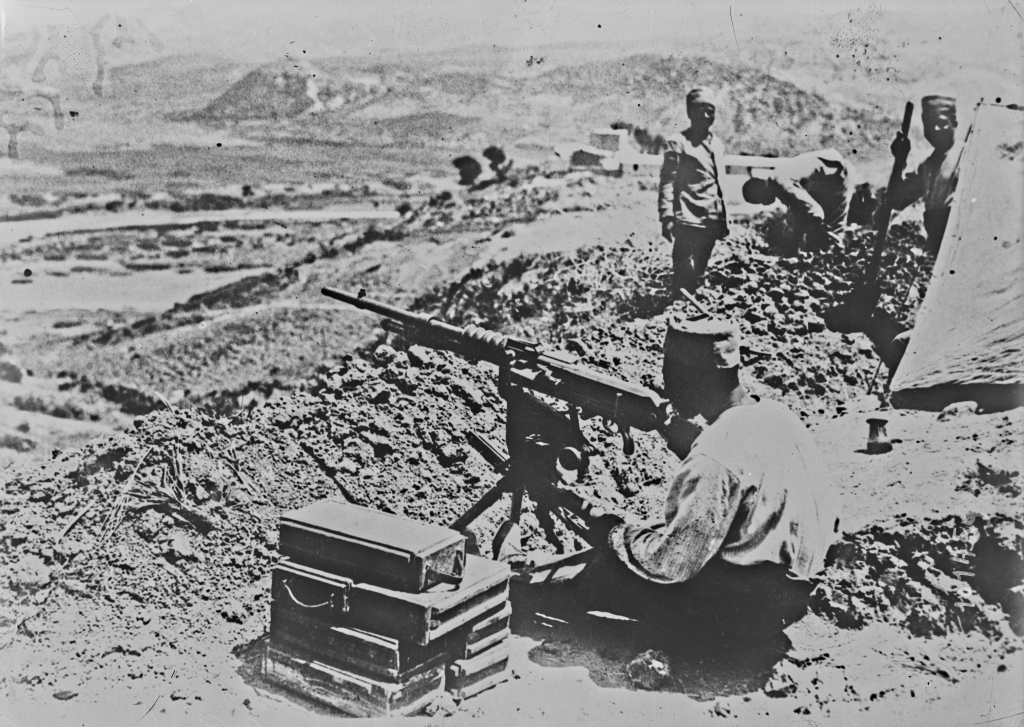
The Rif War originally came about as Spain attempted to carve out a North African empire to compensate for the loss of its imperial territories in the Carribean and the Phillipines in the late 19th Century. By 1920, Spain occupied the coastal regions between Melilla and Cueta (as well as the Spanish Sahara down south) while the rest of what is modern-day Morroco was a French protectorate. Among these two territories lay the Rif Mountains, inhabited by fierce Berbers who handled their rifles like hunters and ranged across the rugged djebels like mountain goats. The Iberians’ military debacle will be summarised for context; Spain’s army of conscripts led by a low-calibre officer corps launched an offensive aimed at occupying eastern Morocco. Yet in July of 1921 the Riffian tribes led by Abd el-Krim defeated and routed the Spanish all the way back to Melilla, losing 13,000 out of 23,000 men in what was the worst ever defeat by a European colonial army. Although the Spanish managed to recover some of their losses, ultimately by 1925, they remained on the back foot. The French watched on, not too upset at their regional rivals’ plight, that is until they got their own taste of Berber hospitality.
The Gauls established positions north of Oureghla River with a line of tenuously held blockhouses manned by 20 battalions of African riflemen. The northern cities in France’s protectorate had been providing the Riffians with contraband and foodstuffs until the French commander Lyutney cut the supply. El-Krim, dismayed at this, attacked the French positions with about 8000 irregulars in April. They caught the French unawares, isolating and annihilating a number of positions. Just four mobile battalions, supported by 180 combat aircraft, struggled to relieve the French positions being swarmed all along the line but could not be everywhere at once. The French line was breached in June, and now el-Krim’s forces threatened the cities of Fez and Taza which forced the French to evacuate them to avoid the risk of a massacre. In August, the French pulled back south of the Oureghla after suffering 5000 casualties, including 2000 dead and 48 out of 66 outposts lost.
Faced with the failure of his strategy, General Lyautey had to relinquish command to General
Pétain. The European neighbours now formed an alliance and in September launched a massive offensive to crush the Riffians once and for all. Whilst the Spanish landed a heavily-armed army of 18,000 to attack south, the French sandwiched the berbers with a 20,000-strong thrust north. El-Krim could not field enough tribemen to counter such numbers and, in 1926, he surrendered to end the Rif War.
 History and Things