
“History is written by the winners,” quipped Napoleon. Despite France’s vast compilation of conquests at home and abroad, historians found space to record the occasions this superpower was mauled also.
This four-part article includes the worst military calamity of every decade, from the founding of the First Republic in 1792 until Algeria’s independence in the 1960s – failures little and large that resulted in losses of men and matériel, strategic reversals, and political trauma.
Battle of Neerwinden (1793)

In 1789, a cataclysm occurred in France; the French Revolution overthrew the Ancien Régime, and out of the political rubble emerged the Tricolour of the First Republic. Chaos reigned as this neonate republic struggled to find its footing with enemies swirling around it, both home and abroad. Two of those were Prussia and Austria. They pledged to do what they could to restore the old regime so the National Assembly ordered the army to neutralise the threat of invasion by the soon-to-become First Coalition in the Austrian Netherlands. In 1792, three French armies marched into modern-day Belgium, defeating the Austrians in battle and capturing numerous fortified cities whilst supreme commander Charles Dumouriez had ambitions to occupy the Dutch Republic. Yet, the Austrians countered and forced the French back to Leuven by 1793. Dumouriez was now ordered south to take charge of the demoralised French. Believing a further retreat would open the flood gates to mass desertions, Dumouriez chose return to the offensive and confront the Prince of Coburg’s Austrian army near modern-day Neerwinden on March the 18th.
Both armies numbered over 40,000 men but the Austrians possessed a greater proportion of cavalry that was better led than their French counterparts. Dumouriez divided his army into eight attack columns and directed them to focus on the Austrian’s left wing. The French advanced and captured Racour, Oberwinden and finally Neerwinden, yet they were bitterly contested and changed hands many times whilst Austrian cavalry charges were highly effective in the open ground between the settlements. Finally the Austrians took the villages and a cavalry charge pressed the French back even farther. As the day wore on, the French withered in the face of the enemy’s alternating infantry/cavalry assaults their own horsemen were too inadequate to contend with. The French left finally collapsed, and with it Dumouriez ordered a general retreat.
The French lost about 5,000 men to the Austrians’ casualties of under 3,000, yet thousands of French also abandoned their colours within hours of the battle to the extent that when they faced the Austrians five days later, their army had shrunk to half its size. Dumouriez subsequently negotiated a peaceful withdrawal of Franco forces back to the border. France’s Flanders Campaign was lost which piled huge political pressure on the tumultuous Republic. Riven as it was by factional infighting, paranoia and zealotry, the National Convention looked for heads to roll, and so Dumouriez defected to the 1st Coalition in order to preserve his. The reverberations of this treachery instilled even greater paranoia in Paris, purging the government of its moderate elements and influencing the start of France’s Reign of Terror.
Battle of Vertières, 1803
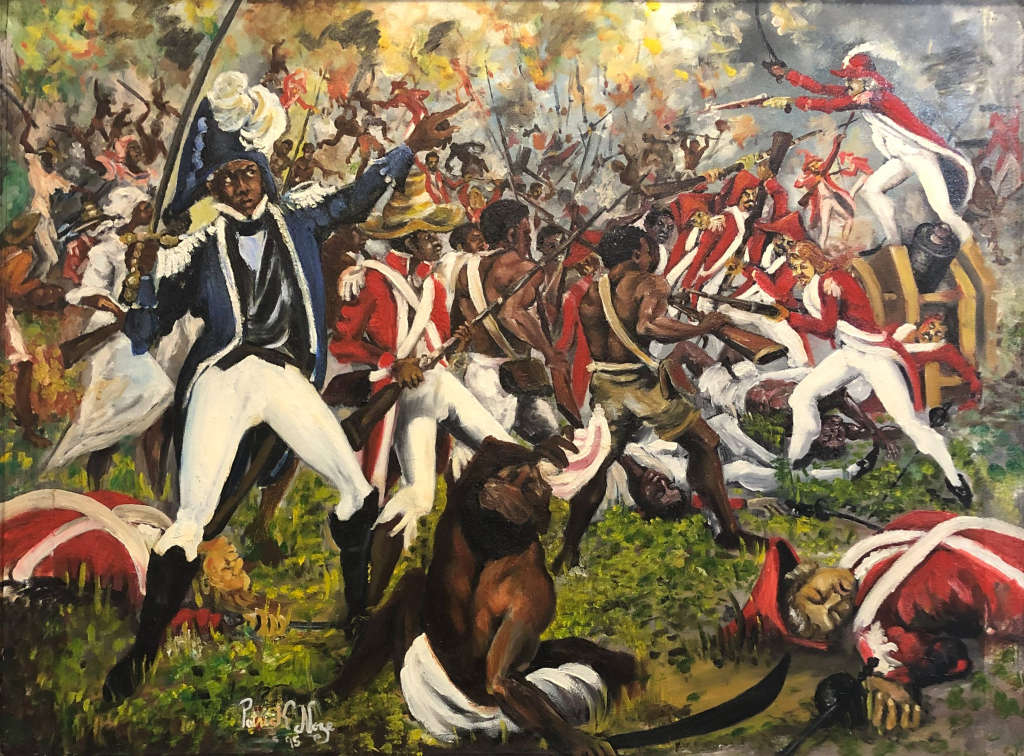
The spirit of revolution that overthrew the Ancien Régime in France translated into overthrowing the French regime across the Atlantic in Saint-Domingue, modern-day Haiti. The Haitian Revolution broke out in 1791 with Toussaint Louverture at its head. After an armistice was signed with the French in 1802, Louverture was captured and imprisoned before Napoleon reinvaded the island and, with it, reintroduced slavery. Louverture’s lieutenants resumed the campaign to end their subjugation, be it by wiping out or driving out the French. Swathes of French troops soon succumbed to yellow fever before war broke out with the British to pile trials upon tribulations. With the Royal Navy at sea and rampant Haitian armies on land to contend with, the French campaign, commanded by the cruel white-supremacist General Rochambeau, faded and by October they had retreated to Le Cap. The Haitian revolutionaries, commanded by the equally bloodthirsty Dessalines, closed in to finish off their quarry.
November the 18th was the final showdown; the French prefering death on the battlefield over a slow demise from yellow fever; the Haitians, after 12 years of bloodletting, were fatalistic come what may on this eve of victory. Over 5,000 French occupied Vertieres and outlying forts against a Haitian army that possesed a few cannons. A demi-brigade advanced towards the town’s defences up a ravine but was repulsed by Rochambeau’s own cannons and musket fire several times, Commander Capois relentlessly drove his men to keep assailing the French battlements, even after his horse was shot out from under him. This earned him the admiration of his counterpart Rochembeau, who called a halt to French fire and dispatched an officer to compliment Capois’s indomitable spirit. Finally, the French summoned their reserves and grenadiers for a final-ditch counterattack on their foes which was beaten off with much bloodshed. A fierce lightning storm then drew the battle to a close. Rochambeau retreated then surrendered the next day.
Within 10 days the French Army were gone and, within two months, Dessalines declared Haiti independent. The French had lost their ‘pearl of the Carribean’, establishing Haiti as the Carribean’s first independent state. France took time to acknowledge Haiti’s independence and it wasn’t until 1826 that King Charles X formally recognised the Republic of Haiti but insisted on a whopping 90 million Francs in recompence.
Retreat from Russia, 1812

Emperor Napoleon I – the most supreme military leader Europe had seen in hundreds of years – had achieved hegemony over most of continental Europe within a decade of coming to power in 1799, and felt it only appropriate that Imperial Russia should also be brought into line. This was certainly a case of Bonapart having eyes bigger than his stomach and, ultimately, was the beginning of the end for the man. Despite Napoleon’s diligent preparations, France simply lacked the resources and logistical infrastructure to adequately supply an invasion force that came to number over 600,000 men. When Napoleon led his men across the Neman River in the height of summer, he believed a foray into Russia would bring Emperor Alexander I to sue for peace within a month. Not so; the Russians would not be cowed. Instead, the French Army was drawn into a campaign of occupying more and more cities in an effort to force Alexander to submit, all the way to his seat of government in Moscow – 600 miles east.
The Russians, with their uniquely vast strategic depth, could afford to retreat in front of their invaders, making only rearguard engagements, knowing that ‘General Winter’ and the tyranny of distance would degrade the French Army for them. The French trudged on and on, their men and valuable horses dropping like flies from fatigue and starvation despite stripping the land and towns of supplies to make up their shortfall. Napoleon took Smolensk in August and, after the unfulfilling Battle of Borodino, the French finally reached the ‘summit’; they entered Moscow, a city ablaze, empty of people, and prospects. There, they languished as the Russian campaign of attrition wore them down. The Russian Emperor was as implacable as ever as his army strength grew. Napoleon, dismayed at his enemy’s ruthlessness, abandoned Moscow in October to march home on a south-westerly route where the earth had not yet been proverbially scorched. It was at the Battle of Maloyaroslavets that defeat then turned to catastrophe. The battle for the village was fierce, with the Italian Royal Guard, in particular, fighting well. The village changed hands no fewer than eight times in what was a French victory, but yet again, the Russians evaded destruction and retreated to a blocking position that forced Napoleon to return his tired remnants back along the northern route home. Winter now bit deep. Bonapart’s army fell apart in a desperate, forlorn two-month long rout. The enemy harried the French relentlessly as they died in droves in -30C snow drifts, or from hunger that drove them to cannibalism and suicide. Just 110,000 frostbitten and half-starved survivors stumbled back to Poland by Christmas.
The wings of France’s imperial eagle were definitively clipped. The flower of its army was now lost and was irreplaceable in the short-to-medium term. Napoleon’s enemies, after years of repression, rose up. Prussia joined the allied camp and the War of the Sixth Coalition commenced in 1813, resulting in Bonapart’s eventual defeat and exile to Elba.
Three Ships Sunk, 1828

Little is written of it, but during the Morea Expedition – a military and scientific expedition to Greece with the main aim of ousting Ottoman forces from the Peloponnese – three French ships sank in a storm. On the night of September the 16th, the ships, including the brig Aimable Sophie which was transporting the 3rd Chasseur Regiment’s horses, succumbed to raging winds and waves while on their way to Petalidi as part of the expedition’s 2nd Convoy.
Battle of Macta, 1835

By 1830, the popularity of King Charles X‘s monarchy had sunk dangerously low, and in Charles’ desperation, he looked for a military conquest on foreign shores to shore up his popularity. Algiers was one of the Barbary states whose corsairs had been the scourge of Christendom for centuries under the auspices of the Ottoman Empire. This certainly ended once France invaded and overthrew the Dey of Algiers in a three-week campaign, although their operations had been winding down for decades prior. The arrival of the French provoked a great leader, the young Emir Abdelkader, to rise and unite the Algerian tribes and drive them off their shores. The French noted Abdelkader’s growing power, so tempted two tribes that had joined the Emir’s army to defect. Angered, Abdelkader despatched one of his agas to marshal the two tribes back into the desert interior. With French honour at stake, this was considered a de-facto declaration of war. Without waiting for orders, divisional General Trézel set out with an undersized army to bring the Emir to submission. Trezel’s 2,500 strong force consisted of three battalions each of French, Africans, and Foreign Legionnaires; an African chasseurs regiment; plus several artillery pieces. They would face 12,000-15,000 Algerians – mostly cavalry plus some modern rifle battalions. Abdelkader lay his infantry as a blocking force in the brush-covered foothills of the Atlas mountains which Trezel’s vanguard bumped into at the Battle of Sig on June the 26th. The French, raked with fire and slammed by an impetuous cavalry charge, folded after Colonel Oudinot fell. Trezel hastily retreated to save the rest of his army.
The next day, the French, now encumbered by many wounded piled upon their slow caissons, embarked towards French lines along a road that led along the Macta River and through a defile. They set off in the cool of the morning. The Algerians, with an 8-1 superiority of numbers and high mobility in their cavalry, started attacking the French from every angle. As the soaring sun began to torment Trezel’s men, so Abdelkader’s warriors incessantly harried them on their march towards the defile. Trezel wanted the Hammianes Heights secure, so ordered two infantry companies to take them, yet masses of Algerian infantry hid on the reverse side of the hill. Their numbers easily drove off two infantry companies followed by another two. As the Legionnaire battalion broke away from the main formation to support these piecemeal assaults, the Algerian cavalry saw their opportunity to drive a wedge between the French. This charge was checked by the French Chasseurs, yet the army fell in on itself, leaving the wounded-laden caissons exposed. A gory, gleeful massacre proceeded as soon as Abdelkader’s horsemen fell upon the carriages. Trezel’s remaining guns frantically fired grapeshot into the swarming enemy whilst his chasseurs performed wonders to save the army from annihilation.
Finally, the French reached the sea air. They survived whilst the Algerians’ ardour was quenched from looting and butchering. The French suffered 500 casualties to the Algerians’ 2000, yet the field was truly Abdelkader’s. As the heads of French soldiers were piled up in their hundreds, the Gauls’ confidence was so shaken they felt safe only once evacuated by sea from Oran. In the short term, this severe drubbing led to the recall of generals Trézel and the comte d’Erlon, but Abdelkader would be decisively defeated in the Battle of Sikkak 11 months later.
 History and Things