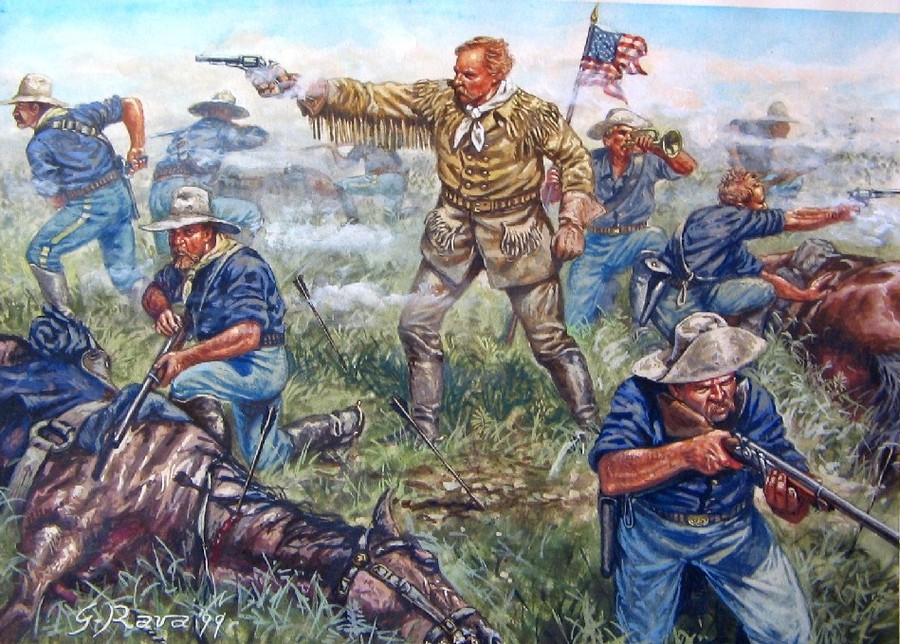
Click for part 1
USS Hornet Sunk, 1829

A large US Navy sloop-of-war was lost in 1829, albeit in a maritime disaster rather than a military one. The USS Hornet was a 440-ton ship armed with 20 cannon and had a distinguished record as the first U.S. Navy ship to capture a British privateer in the War of 1812.
The Hornet had been patrolling the Caribbean throughout the 1820s, conducting anti slavery and anti-piracy operations but was never seen again after setting sail for Mexico from Pensacola in March, 1829. It was reported that USS Hornet was dismasted in a gale off Tampico in September and foundered with all hands lost.
Dade Ambush, 1835
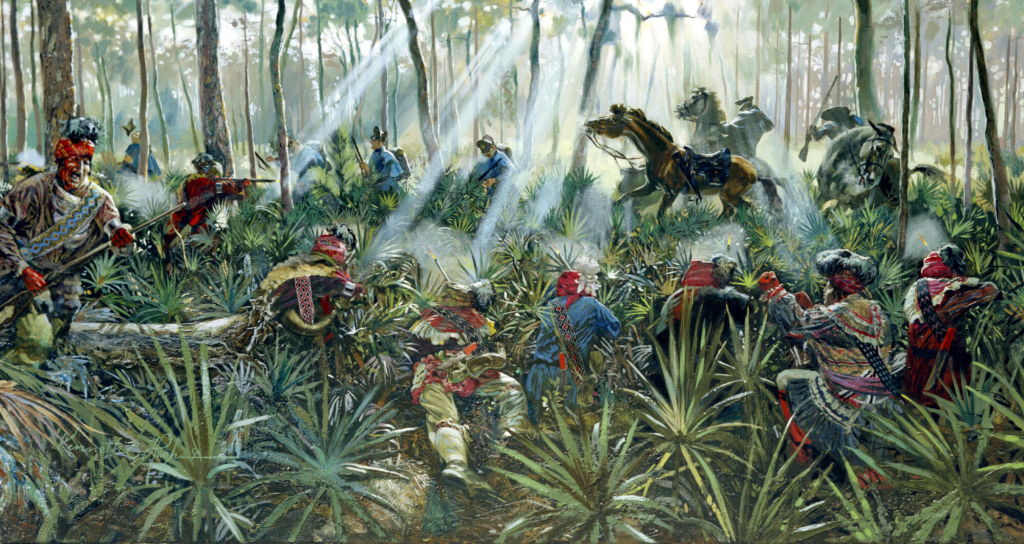
Two companies of US Army troops were wiped out by Seminole Indians in the winter of ’35. Hostility had been building between the Seminole Indians of Florida and the US Government. The upshot to their discord was that, with US settlers encroaching on Seminole lands, the US Government wanted the Seminole off the peninsula and onto a large reservation in modern-day Oklahoma. Needless to say, the Native Americans were not keen on the idea.
Two days before Christmas, Major Francis Dade set off from Fort Brooke to march 90 miles north to Fort King on a reinforce-and-resupply mission. Under his command were 110 men plus a 6-pounder cannon. Trekking through swampland, the troops marched in a double line formation with flanking scouts deployed because it became evident they weren’t alone out there… Seminole warriors were stalking them watching their every move. Dade’s column eventually made it out of the marshes and onto firmer, clearer terrain and felt they were on the home stretch. But it was at this stage, the Seminoles, headed by Chief Alligator, chose to strike. 25 miles south of Fort King, 180 warriors laid a carefully prepared ambush and on December 28th, Dade and his men trudged obliviously into it. Dade himself was blasted off his horse with the first shot before fire erupted from amidst the spiky palmettos that hid the Indians. The first fusillade reportedly felled half the soldiers before they could even raise their muskets. Some survivors attempted to make a last stand behind a log bulwark, but Dade’s entire force was wiped out, save two men. The Seminoles suffered just eight casualties.
The Native Indians then went on the rampage. They attacked the plantations of the settlers and, by the end of 1836, all but one house in the region had been burned to the ground. Thus began the 2nd Seminole War which the US emerged victorious from six years later.
Battle of Dominguez Rancho, 1846

War broke out between Mexico and the USA in 1846 as it was the Americans’ belief that the conquering and settling of temperate North America was their ‘Manifest Destiny,’ yet Mexico’s territories still stretched as far north as the modern-day Oregon, Idaho and Wyoming state boundaries. It was eventually decided under President James Polk’s tenure that Mexico’s most northerly provinces should be acquired through war.
US forces headed by Commodore Robert Stockton managed to take Alto California – Modern-day California – and entered the ‘pueblo’ of Los Angeles unopposed. The garrison of 48 did not enamour themselves to the naturalised Mexicans around Los Angeles, known as Californios, due to their ill-disciplined and harsh treatment of the townsfolk, and so the Californios ran the Americans out of town in a bloodless uprising. Stockton reacted by despatching US Navy Captain Mervine from San Pedro to march north and re-establish control of LA with a force of almost 400 troops, mostly US Marines. Mervine’s march was poorly planned, his troops possessing neither horses, wagons nor cannons. They would be skillfully opposed by a mounted force of 50 Californios – poorly armed also, but in possession of fine horses and an old brass 4-pounder cannon. Mervine began the first leg of his march on October the 8th on a long, six-hour slog to the abandoned Dominguez Rancho and the Mexicans harassed the Americans while exaggerating their numbers by strategically running horses across the dusty Dominguez Hills. On day two the Americans set off from the ranch but were soon stopped in their tracks. A cracking boom from the 4-pounder signalled battle to commence and the Mexicans hit Mervine’s force on the flanks with mounted musket and cannon fire. Mervine’s marines could do little; advance towards Los Angeles and they were assaulted yet if they tried to return volley fire, the latinos simply kept out of range. Finally Mervine accepted they were on a hiding to nothing in the face of this force assailing them from all sides. With casualties mounting, they retreated back to San Pedro.
The Americans suffered 22 casualties and even lost their US Colours to the enemy for no losses to the Mexicans in return. Mexico held on to Los Angeles until January of the following year.
Battle of Cieneguilla, 1854

A large company of US troops was decimated by Jicarilla Apaches in New Mexico. The Jicarilla and Ute Indians had been trying to resist the expansion of white settlers onto their territories by committing frequent attacks and massacres on them. The US Army was eventually compelled to retaliate and declared war on the Native Americans in 1849. The 1st Dragoon Regiment launched an expedition into Apacheria in March 1854 after a herd of cattle were raided by a band of Jicarillas near Fort Union.
Sixty dragoons led by First Lieutenant John Davidson set off from Cieneguilla. Passing through a canyon, they were unaware that a large Jicarilla encampment was up ahead and the canyon’s stethoscopic qualities sounded the alarm of the mounted soldiers’ approach. Thus, when the dragoons did arrive the Native Indians were ready and waiting. Davidson’s men sighted the Jicarilla’s camp up a slope. Chants and war whoops rang among the rocks to goad the dragoons into attacking, so Lieutenant Davidson accepted the challenge. The whole point of dragoons was to deliver highly mobile fire-power but Davidson foolishly opted to dismount his men to advance on foot and labour up the hill, with one-in-four of them left to hold the horses. Davidson was merely playing into the enemy’s hands. He entered the enemy encampment and there engaged some warriors yet this allowed for the Indians to double envelop them. Cries of alarm from down the slope sent the Americans scrambling back to defend their colleagues, and there fighting escalated. Up against 200-300 warriors, arrows started raining down on the blue-coats whilst they got sniped at with rifle fire from the brush. Davidson saw that his men were fighting a losing battle so ordered a retreat up a ridgeline. The Jicarilla warriors were canny enough to intercept their line of retreat however, and like hornets, swarmed around the dragoons again, assailing them with showers of arrows. Davidson’s men began dropping like flies now and the retreat turned to panic. The survivors fled for their lives.
The blue-coats suffered 22 men KIA plus 23 injured that day. Davidson came under scrutiny for his decisions but was eventually exonerated. He’d picked a fight he probably shouldn’t have, then was out-maneuvered and out-fought. The Jicarillas would be caught and defeated later next year.
Battle of Harpers Ferry, 1862

For four years, total war tore the United States asunder because a range of ideological, economic, political and social fractures, of which the abolition of slavery was the most salient, could not be reconciled. 17 months deep into the war, General Robert Lee was leading the Confederate war effort on the front foot and ordered Major General ‘Stonewall’ Jackson to capture Harpers Ferry in order to secure his lines of communication.
The garrison there was 14,000 men strong but vulnerable because it was surrounded by towering hills all around; the Bolivar Heights to the west, the Maryland Heights to the north-east and the Loudoun Heights to the south-east. Miles deployed two brigades to hold the Bolivar Heights, and 1,600 men to maintain a vigilance atop the Marylands. The Loudoun Heights, however, Miles neglected to hold at all. One may guess what happened… While the Union’s western flank was initially secure enough, General Jackson attacked the Maryland Heights with two of his best brigades and took them easily, its battered Union defenders stumbling back into town which caused morale to slump. Miles was rocked further to discover General Jackson did possess the basic initiative to reconnoitre the Loudoun Heights and had therefore found them free of defenders. Jackson ordered artillery to be hauled up there and place Harpers Ferry squarely in their sights ASAP. Miles’ position was hopeless now that he was under cannon fire from all sides. The Colonel had allowed his position to unravel so quickly – within three days – that Union relief forces could not save them in time. Indeed, Miles could not even save himself; as he gathered his officers to discuss calling a truce and surrendering, he was hit by a shell explosion and died the next day. The remaining garrison of 12,500 men were surrendered to Jackson on the 15th of September.
It was the largest number of US Army troops to be surrendered in battle until World War II, despite suffering less than 300 casualties. Additionally, the Union Army provided its enemy with 70+ artillery pieces and 200 wagons. General Lee was overjoyed with this great and easy victory, yet it seems the loss of Harper’s Ferry did little to affect the tide of war going in the Union’s favour; Lee and Jackson fought and lost the bloody Battle of Antietam two days after Harpers Ferry. The Union North achieved ultimate victory in May, 1865.
Battle of the Little Bighorn, 1876
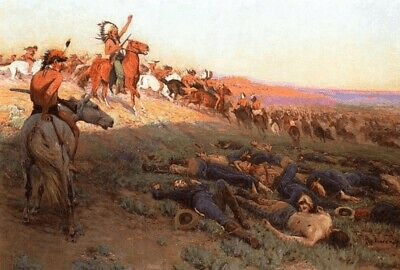
On June the 25-26th in modern-day Montana, Colonel Custer and 270 cavalrymen were slaughtered in the last great victory of the ‘noble savage’ over the ‘white man.’ In the late 19th Century, tensions increased between the Native inhabitants of the Great Plains and encroaching settlers. While some of the indigenous people resigned themselves to living on ever-shrinking reservations, a number of them resisted, sometimes fiercely.
Colonel Custer’s 7th Cavalry Regiment was part of a military expedition into Dakota territory to force the Sioux and the Cheyenne back to their reservations. Close to the Little Bighorn River, Custer’s Indian scouts sighted a giant herd of horses in the distance, signifying the presence of a correspondingly large village. Custer decided to attack them before they could scatter. After dividing up his companies into three battalions under the command of himself, Major Reno and Captain Benteen, Custer’s and Reno’s battalions moved up the river towards the Indian village. With the village detected up ahead, Custer ordered Reno to charge in, chase the enemy and to bring them to battle. Yet, there would be no chasing to be done, not by the Americans. Reno’s men careered along the riverbank before being confronted by the sight of an alarmingly vast forest of tepees. Like at Cieneguilla (see above), Reno’s men dismounted, advanced in a skirmish line and shot up the village. 500 mounted Indians then slammed into their right flank and Reno clearly realised his men were up against it. He ordered a retreat. With the Indians snapping at their heels, they made it to some bluffs and linked up with Benteen’s battalion and, bloodied, dug in to recuperate. Custer, meanwhile, attempted a river crossing but was driven off before making a fighting retreat towards a small hill. The cavalrymen fought frenetically as a giant mass of whooping warriors swirled around and cut them down. The soldiers formed breastworks of dead horses; most fought to the death; some put a gun to their heads rather than be taken by their tormentors. Custer’s battalion was entirely destroyed.
Over 300 American soldiers lay dead and wounded but 11 months later, the Sioux War was won. This battle was the Native tribes’ last hurrah before their ultimate submission. ‘Custer’s Last Stand’ holds a special significance in US historical culture; Custer achieved the fame he sought but it was a traumatic setback in the American mission to tame the Wild West.
 History and Things