
Four countries that didn’t have a dog in the fight but, unknown to most, battled in the 2nd World War
World War Two wasn’t called a ‘world war’ for nothing; a whole heap of nations got sucked into it. There was the ‘Big Six’ of course; there were the exiled governments of occupied countries like France; the Commonwealth nations under the umbrella of Great Britain such as Canada and Australia; and ‘side quest’ belligerents like China and Finland.
Yet there were also four fully-sovereign, apparently uninvolved states which went out of their way to fight in WW2.
Mexico
Mexico had demonstrated a firm anti-fascist stance in the lead up to WWII, even more so than their northern neighbour the USA, yet they declared neutrality at the outbreak of war. Their neutral stance soon weakened and they showed a clear bias towards the Allies in their economic supplies of raw materials before the USA joined the fray in December 1941 and Mexico’s support for the Allied war effort intensified. Then, after the Kriegsmarine sank two Mexican oil-tankers, Mexico declared war in May 1942.
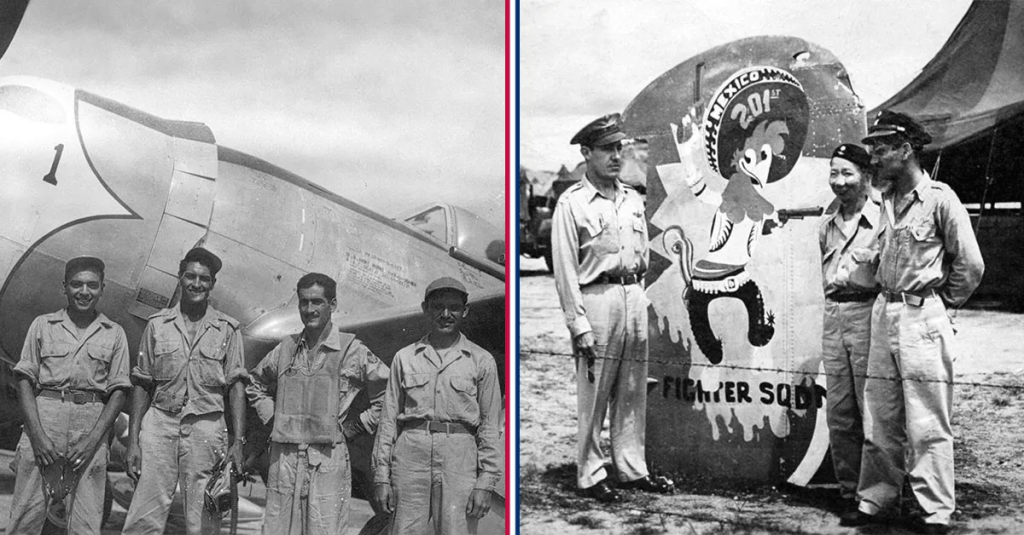
Having now joined the Allied war effort, Mexico was pushed to contribute to the armies arrayed against the Axis powers. This they did by sending the 201st Fighter Squadron in July 1944. It took time for the Mexican Air-force unit to be trained up and equipped, and it wasn’t until the end of April 1945 when they arrived in the Philippines to join up with the US 5th Air-force on Luzon island.
Dubbed the Aztec Eagles, the 201st flew P-47D Thunderbolt fighter-bombers and the unit, comprising 30 pilots plus 300 support personnel, clocked up almost 2,000 flight hours. Missions included performing bombing missions over Luzon and Formosa to push the Japanese out of those islands and they operated in the ground attack role in support of the US 25th Infantry Division. Six pilots died during combat missions.
Spain
The Spanish Civil War of 1936-1939 resulted in victory for General Francisco Franco’s Fascist Nationalist government and it was a victory that Hitler’s Nazi regime had given much support for, including combat and logistical air support from the Luftwaffe’s Condor Legion. It was clear, therefore, that Spain’s foot would firmly be in the Nazi’s camp once WWII commenced. Franco stopped short of crossing the Rubicon and declaring open hostilities against the Allies, however.
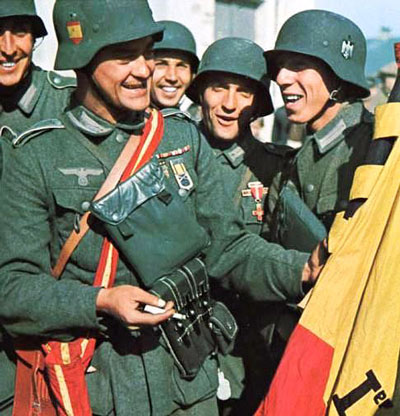
With the launch of ‘Operation Barbarossa’, that humongous and highly successful offensive launched by the Wehrmacht against the Communist Russian state in the 1941, Spanish high command clamoured to return the favour of military support without breaking their ostensible neutrality. The solution was to demobilise Spanish army soldiers then have them join the German army. Those troops formed the 250th Division (plus five fighter squadrons) in an anti-Communist crusade. Although, technically, this was not the Spanish army sent forth to fight in Russia, make no mistake the ‘flesh’ of this division was Ejército, even if the uniforms and ‘steel’ were Werhmacht. As the war progressed the Division, dubbed the Azul Division, would be reinforced with Civil War veterans and students (plus some Portuguese.)
Far off from the warm environs of Iberia for the icy cold of Siberia, the Spanish fought primarily around Leningrad before resisting the Russian offensive in the Battle of Krasney Bor where they held off Russian forces seven times larger than themselves. Hitler privately spoke of the Iberians, saying:
“…the Spaniards are a crew of ragamuffins. They regard a rifle as an instrument that should not be cleaned under any pretext. Their sentries exist only in principle. They don’t take up their posts, or, if they do take them up, they do so in their sleep. When the Russians arrive, the natives have to wake them up. But the Spaniards have never yielded an inch of ground. One can’t imagine more fearless fellows. They scarcely take cover. They flout death. I know, in any case, that our men are always glad to have Spaniards as neighbours in their sector.”
The Division was disbanded in 1944 once the writing was on the wall about the direction the tide the war was taking. 45,000 soldiers served in total in a division 18,000 strong which suffered 5,000 dead plus almost 9,000 wounded.
Brasil
South America’s largest and most populous nation appeared to have little reason to get involved in the war raging far from its shores. Brasil’s population was largely rural and illiterate and its economy was underdeveloped for supporting a large military campaign. At the outbreak of war Brasil subsequently declared itself neutral and tried to juggle its export market between the USA and Germany.
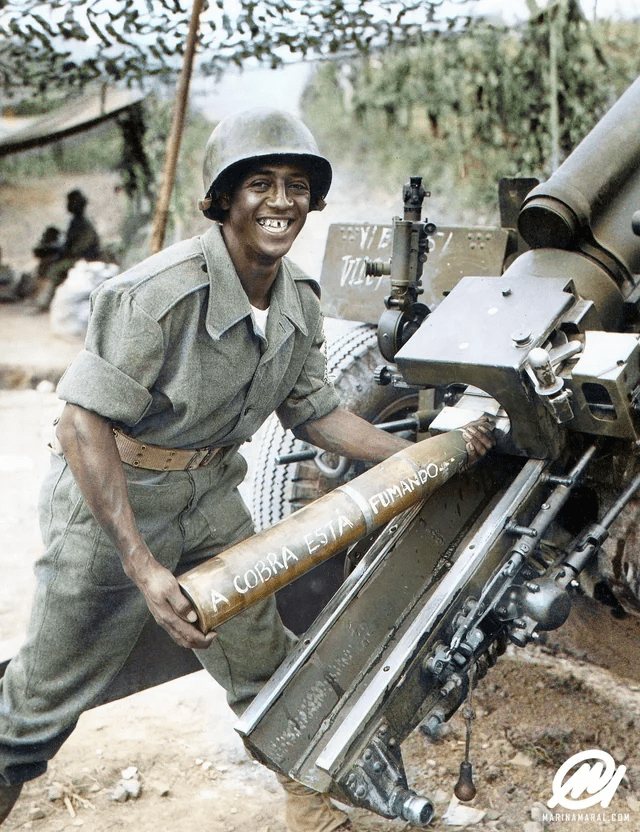
As America entered the war, however, Brasil cast off its trade links with the Axis powers and allowed US airbases to be built along the coast to protect the Atlantic convoy routes. Like with Mexico, this provoked an obnoxious reaction from the Nazis; they began attacking Brasilian shipping, sinking 13 ships between January and July of 1942. Brasil therefore declared war with the Axis powers. And it wasn’t just a symbolic involvement, Brasil raised an Expeditionary Force 26,000 men strong of four regimental combat teams to fight in Europe. The 1st Fighter Aviation Group was also raised – all armed and equipped by the USA.
It took over two years for the Expeditionary Force to alight in Italy, but once it reached the front lines the force, dubbed the Smoking Snakes, accorded themselves well. Known for their tenacity and bravery, the Brasilians fought with distinction in several battles, most notably at Collecchio, Camaiore, Monte Prano, and Serchio Valley.
A German officer once quipped to a counterpart: “Frankly, you Brazilians are either crazy or very brave. I never saw anyone advance against machine-guns and well-defended positions with such disregard for life … You are devils”
Towards the war’s end they captured 20,573 Axis prisoners, including two generals. They lost over 900 combat losses across all three services throughout the war.
Nepal
Ever since the Anglo-Nepalese War and the signing of the Treaty of Segauli between Nepal and the British Empire in 1816, the mountain kingdom has been a great and much-appreciated ally of Britain’s. The Nepalese allowed Gurkhas to be recruited into the armies of British India – a great supply of highly-formidable soldiers throughout the centuries who continue to serve in the British and Indian armies today.
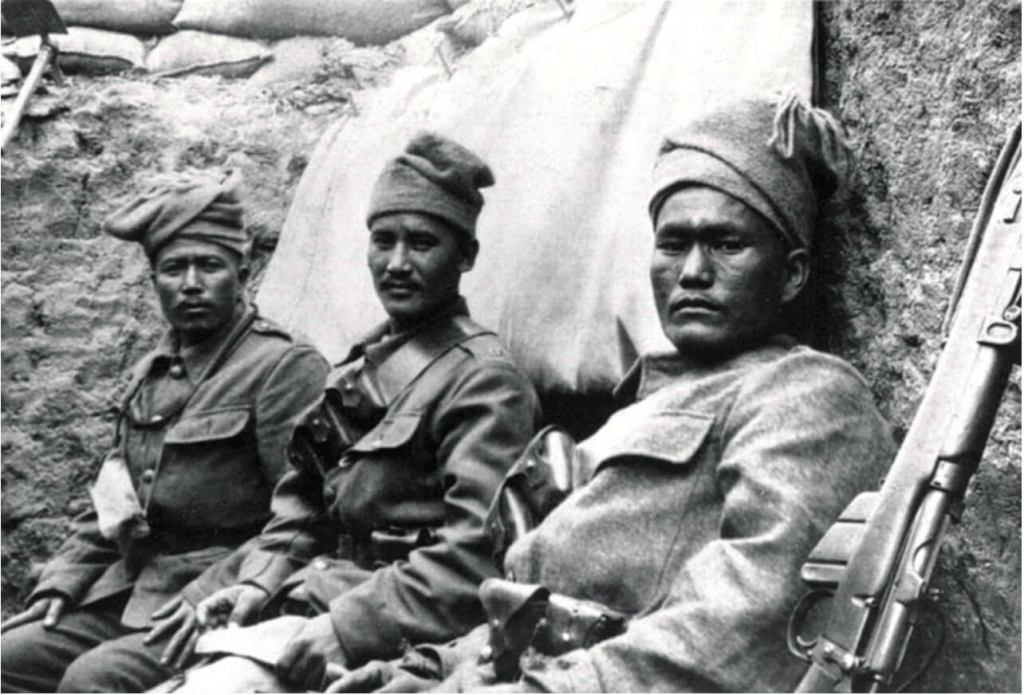
The Nepalese Government also gave faithful support to Britain in its wars, adopting the mantra that ‘an enemy of yours in an enemy of ours.’ Thus, Nepal sent its army south to help Britain put down the Indian Mutiny in 1857, provided material support to Britain in WWI and, with the outbreak of WW2, declared war against the Axis. They immediately deployed four Nepalese Army battalions to Burmese border. They would send a total 17 battalions to the Burmese Front to resist the Japanese, as well as provide material support. These battalions served with distinction with the British 14th Army in the South-East Asian jungles until the Japs were finally forced into surrender in 1945.
 History and Things
Leave a comment