A light-hearted look at what European club football might look like in the not-too-distant future.
It’s no exaggeration to declare that European football is the apex of the world’s beautiful game.
It has the globe’s best players and coaching staff, and draws in a mindbogglingly huge global audience to both UEFA’s flagship Champions League as well as Europe’s best domestic leagues.
Yet, as the world contracted, calls were made for a new ‘Super League’ for Europe’s biggest clubs to compete with eachother.
This call crystallised into the founding of the European Super League in April 2021. The concept was for 20 of Europe’s elite clubs to play each other every week in a round-robin format, but with the 12 founding clubs being protected from relegation.
In what was perhaps the most popular and unifying response since the dawn of time, literally everyone, from the humble fan to the UEFA president, was up in arms about a move that would have removed some of Europe’s top players and clubs from the egalitarian UEFA footballing landscape into an exclusive league of their own.
There was so much hostility to the formation of the ESL, it was quickly suspended, perhaps indefinitely.
Amongst all the rabid arguments in opposition, perhaps the main one was not so much the idea of a European football league per se, but a lack of participation opportunities the ESL offered to the jostling mass of football clubs left out in the cold.
So, is a European ‘Super League’ viable with full access to all football clubs on merit? I believe so.
Why the Need for an ESL?
There’s a lot of clubs in Europe with big budgets, fanbases and trophy rooms but are trapped in leagues that can’t challenge them, That is no good for keeping fans captivated or attracting new ones.
More and more superstars and spectators are drawn to UEFA’s top 3-4 leagues. This means a lot of UEFA’s leagues are withering on the vine. A handful of clubs in UEFA’s less glamorous leagues, such as Ajax, Benfica and Celtic, to name a few, which are still capable of reaching the Champion’s League Group Stages have fallen behind UEFA’s top clubs compared to their global standing in the 20th Century.
The English Premier League in particular is seen as the European Super League they are not a part of but where a lot of their talent is leached from, and they want a piece of the pie.
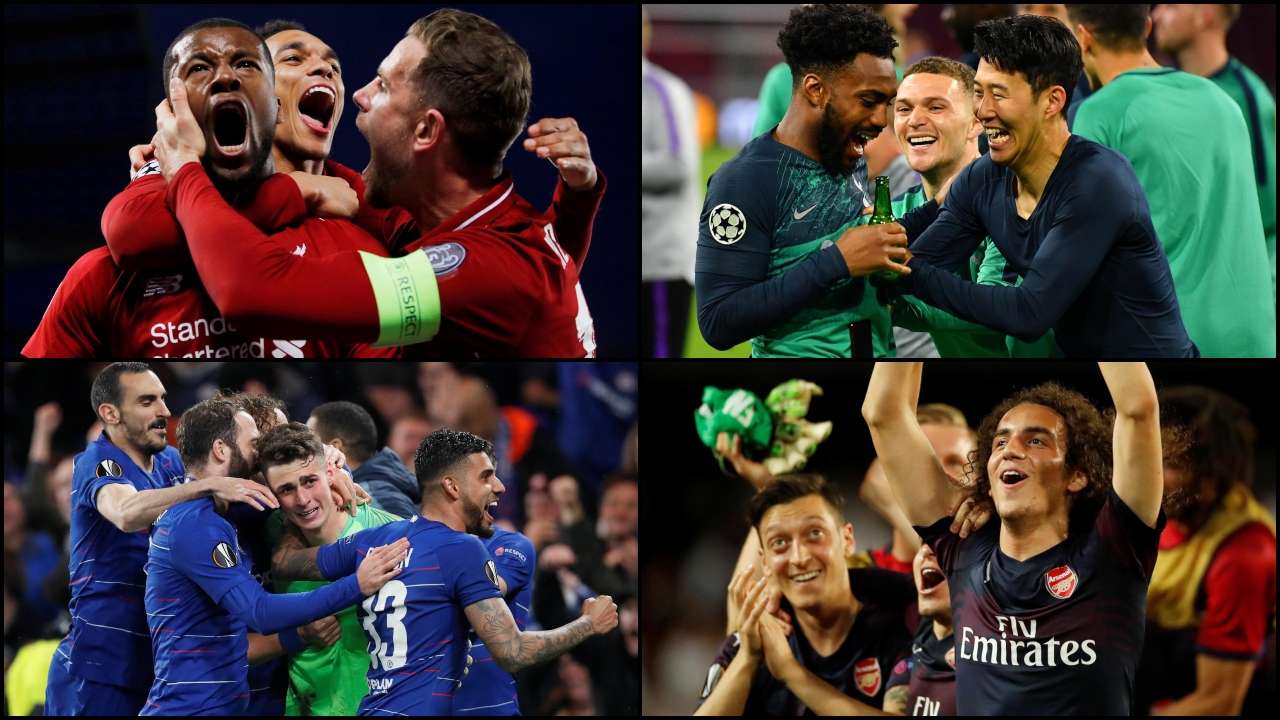
Accept it. UEFA’s domestic leagues will amalgamate into a continental league as inevitably as it was when England’s regional football prior to the 1880s merged into the nation-wide English Football League. It’s just a matter of time!
Let’s have a little fun therefore, and imagine how Euro club football will be by the year 2040…
‘UEFA Super League’
It is the inaugural season of UEFA’s Super League which Europe’s biggest clubs have been anticipating with bated breath for some time. Famous giants like Liverpool, Real Madrid, Bayern Munich and Juventus will now be pitted in the ultimate footballing arena.
Old city and national rivalries will morph into new cross-continental ones. Some clubs look forward to the coming years more than others.
In the year 2040 the Super League (SL) comprises three divisions – SL1, SL2 and SL3 – each comprised of 20 clubs. The first 60 clubs to join the league have been selected based on their position in UEFA’s Team Ranking for 2039–40. (For this hypothetical, the 2023-24 UEFA rankings are used)
For the first season England has seven clubs qualify, four in SL1; Germany has five clubs qualify, three in SL1; and Spain also has seven and five of those enter UEFA’s top new SL1.
Throughout all three divisions, clubs from nations as wide-ranging as Serbia, Scotland, Ukraine and Belgium are in the mix. Promotion and relegation works on a ‘four-up- four-down’ system. The SL1 Title winners will be joined by the other top-6 teams to qualify for an enlarged FIFA Club World Cup.
Domestic Football
The remaining clubs continue in their trifling Premier League, Serie A, etc., leagues and cup competitions, now of course without their strongest clubs. The equivalent to the current English regional non-league pyramid in relation to the English Football League (EFL)/Premier League above it.
Champions Cup
The league champion of all 55 UEFA members will enter a knockout competition the following season. The four semi-finalists of that qualify for promotion to SL3, replacing the bottom four from SL3.
Europa Cup
The old Champions League has been revamped. It is now called the Europa Cup and is a straight knockout competition of six rounds which the 60 Super League teams compete in (plus the four relegated). The two finalists qualify for the FIFA Club World Cup.
Now, it is akin to England’s League Cup or Germany’s DFL Ligapokal, etc., in terms of its format, except it’s the premier knockout competition in Europe.
FIFA Club World Cup
The FIFA CWC is now an enlarged 32 team competition starting from the second season. Eight UEFA clubs (top-6 of SL1 and both finalists of Europa Cup) will join 24 more from FIFA’s five other continental ruling bodies to compete in an annual group stage/knockout competition.
It will now replace the old Champions League as the greatest cup competition in the world, as it was meant to have been when it began all those years back at the dawn of the century.
Summary
So, there you have it. A possible football landscape with a pan-European Super League where Europe’s greatest titan clubs will aim to compete for true global domination. A European straight knockout cup competition of six rounds, replacing the domestic cups once so prized; an expanded club-world-cup for the Super League’s best squads to compete on an even more global stage. This, in a world where clubs in the ‘Oil states’ and N. America’s burgeoning MLS could provide an ever tougher challenge to European hegemony.
It could be an exciting future. The grassroots passion of traditional, local fanbases may fade, but it could also see global fanbases proliferate until the game in the future becomes more a lifestyle than sport.
 History and Things