
Click for part 3
Battle of Bataan, 1942
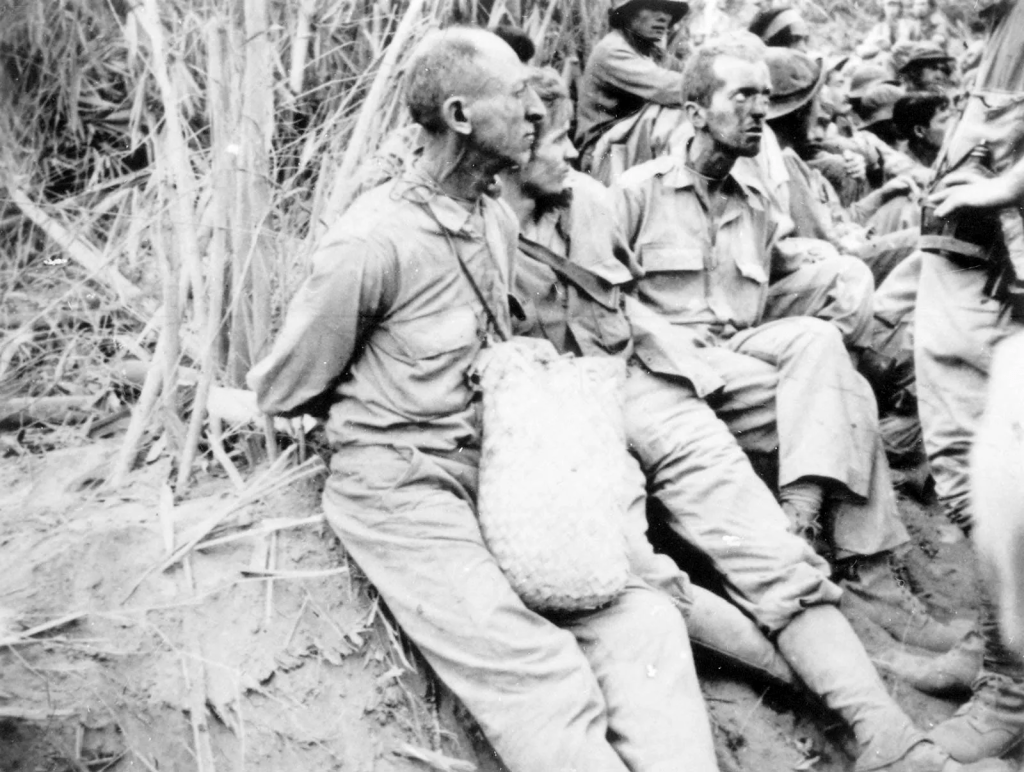
With many parallels to Britain’s own catastrophic Fall of Malaya & Singapore, the USA lost its final foothold in the western Pacific after US forces fought for and lost the Bataan Peninsula on Luzon island in early April. US Commonwealth forces under the command of General Douglas MacArthur consisted of 76,000 troops, including 15,000 Americans. The plan was to attempt a defence of the landing beaches before making a fighting withdrawal back to Bataan Peninusla. Alongside the Corregidor island fortress offshore, holding Bataan was vital to denying the Bay of Manila to the enemy.
After the Japanese made their landings, US forces made their fighting withdrawal south to Bataan as prescribed. These forces outnumbered the Japanese and put up a stiff fight during a 4-month campaign, but it was in the wider context of a battle they were doomed to lose. This was because American-Filipino troops were completely cut off from supplies and reinforcements from the USA. As the weeks dragged on, they were weakened by starvation rations and tropical diseases, forcing both their morale and defensive lines south. The Japs struggled to subdue the Americans and, by late February, their invasion force had been worn down to a nub. They were forced back from the Orion-Bagac Line to lick their wounds. Reinforced with fresh troops, artillery and bombers, however, the Imperial Army smashed through the final defence line and the US-Philipine defences finally crumbled. Bataan fell on the 9th of April and Corregidor held out for almost another month before surrendering.
The US suffered 30,000 casualties and 79,000 troops, including 12,000 Americans, were taken into captivity to begin their horrific ‘Bataan Death March’. American – indeed, all Allied forces – were now vanquished from the Pacific and the war effort there was on life support for several months.
Battle of Osan, 1950

A strange episode in the US Army’s history when a battlegroup was not battered so much as it proved to be dismayingly ineffective in the face of the enemy. The US presence in the Pacific was still powered down after the brutal Pacific war when 10 divisions of the N Korean Army, armed by the Soviets, invaded South Korea in 1950. The small South Korean Army, little better than a paramilitary force, was immediately steam-rollered. Their capital Seoul was captured in three days and now it became clear to the American-backed UN that they needed all hands to the pump before the entire South Korean republic was conquered. To that end, the US 24th Infantry Division, on garrison duty in Japan, was ordered to Korea and its most combat-ready unit, 1st Bat., 21st Infantry Regiment, was ordered to fly in and try to block the North Korean surge south.
‘Task Force Smith’ consisted of the understrength 1st Battalion plus a battery of artillery. Its men were mostly raw recruits and its antitank bazookas and recoilless rifles were outdated. Plus, its 105mm artillery guns had just six anti-tank rounds in total. TF Smith deployed on high ground around a road leading south and waited. On the morning of June the 5th, the enemy were sighted; a column of eight T34 tanks. American artillery opened fire when they were 1.2mi (2km) out then, as the tanks trundled closer, they were hit with bazooka and recoilless rifle fire. The enemy, however, remained unscathed and plowed through the road-block with contemptuous ease. Once through the main infantry positions, the artillery fired their six anti-tank shells at the tanks which immobilised two of them, but the rest of the T34s fought their way through. The Americans were quite helpless. A larger column of tanks came next. The results were the same; the N. Korean armour advanced with ease as US casualties mounted. Truck-mounted infantry then attacked and 1st Battalion hit them with everything they had, scattering the enemy from their burning trucks. Yet 1st Bat. were heavily outnumbered and the N. Koreans enveloped their positions with over 1,000 troops. With this, Colonel Smith ordered his task force into a retreat that degenerated into a rout as his poorly trained soldiers lost their stomach for the fight. The Americans fled the battlefield, abandoning their equipment and, even, their wounded.
In their first battle of the war, the US Army had performed impotently. They suffered 80 casualties, plus another 80-odd captured. A number of the American wounded left behind were later discovered to have been executed. Clearly, the US Army had neglected its duty in equipping and training its troops properly and realised it needed to get its combat units up to standard for the upcoming war, and fast. The Korean War would be eventually brought to a halt over three years later with both sides starting out more or less where they began.
The Battle of Ong Thanh, 1967
Two infantry companies were ambushed and virtually destroyed in 1967. It was nine years after the Communist Viet Minh kicked out the French and took control of North Vietnam when the US military began combat operations to stop the North Vietnamese from taking over the rest of the country. By ‘67, US operations were in full swing with the strategy of using their abundant firepower to out-attrit the Viet Cong, and it was getting results.
After the Viet 271st Regiment arrived in an area by Highway 13 to rest and resupply, American high command decided to clear the enemy from the area while disrupting their recuperation and so launched ‘Operation Shenandoah II.’ As the operation progressed, LtCol. Terry Allen’s 2nd Battalion, 28th Regiment was flown in to knock out the 271st Regiment – reportedly on its knees at this point as a result of Op Shenandoah. But intel was faulty. The Viet Regiment may have been tired and hungry but it was 1600 men strong and battle-hardened. It was 2nd Bat. which was about to get put on its knees.
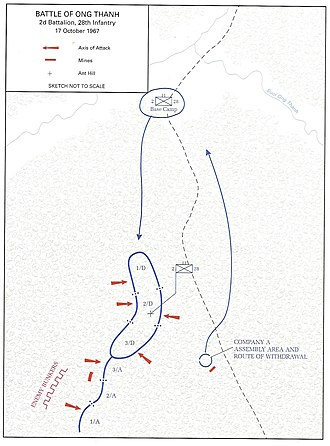
On the 17th of October, Col. Allen, complacent and mislead about the opposing regiment’s strength, chose to lead his ‘A’ and ‘D’ companies (with ‘B’ Coy in reserve) to mop up the 271st Reg. with a frontal assault. Yet, the Vietnamese, now aware of the Americans’ presence in their midst, prepared a three-sided ambush for them. With ‘A’ Coy in the vanguard, Col. Allen’s men advanced southward and came across a trail. As ‘A’ Coy’s 1st Platoon lay an ambush there, the sound of weapons clicking and the rattle of ammunition was heard; 271st Regiment’s jaws now snapped shut. Automatic fire of all varieties ripped into ‘A’ Coy and it was devastated after 30 minutes. With its officers dead or injured, command was handed over to Sergeant Valdez to lead its broken remnants back to the safety of ‘D’ Coy’s defensive perimeter. As ‘A’ Coy passed through ‘D’ Coy’s perimeter, the enemy fell upon them. The Viets were firing captured M60 machine guns that ‘D’ Coy mistook for ‘A’ Coy’s guns, and so they withheld fire in the direction of the enemy, allowing the Viets to gain firepower superiority. ‘A’ and ‘D’ Coys were decimated in vicious fighting. With all their commanders dead or injured, including Col. Allen, their retreat back to base turned into a rout as the US infantrymen scrambled to dodge heavy fire. Of Col Allen’s 150 troops, 139 were casualties, including 64 dead.
It was an unequivocal defeat although the U.S. military told the media that the fight at Ong Thanh had resulted in a major American victory by over-estimating the number of Viet Cong casualties, the true number of which is unknown.
Battle of FSB Mary Ann, 1971

By 1971, the writing was on the wall; Vietnam was a quagmire of a war that could not be won. The South Vietnamese Republic was too stricken with corruption to stand on its own two feet, whilst the enemy was so strong it had managed to launch the massive Tet Offensive three years prior to show the US Government what they were really up against – a motivated and battle-hardened enemy. With political morale so low ‘Stateside,’ US ground forces wallowed in a state of indolence and insubordination barely seen in the US Army before nor since. The US military’s best and brightest were avoiding the theatre and 4-in-10 of the rank-and-file were on drugs. It was to this backdrop that a sapper battalion attacked Fire Support Base Mary Ann and almost wiped out its garrison.
The ‘torso’ of Mary-Ann’s (MA) defences comprised C Company, 1/46th Infantry Reg. to which various other 1st Battalion units were joined – over 200 defenders in all. Commander LtCol Doyle was also present, although his attention lay elsewhere than MA’s security. It’s true the base had been quiet for some time but sentry patrols were uneven and Doyle, himself, failed to post sentries on his command bunker in violation of brigade policy. In a Vietcong subterranean bunker somewhere the Americans’ sloth had been noted. At predawn on the 28th of March, 50-100 sappers armed with satchel bombs, RPGs and AK47s, crept up on MA’s perimeter then worked their way through the concertina wires to within 20m (66ft) of MA’s trench-ring of interconnected bunkers.
At 02:30, a storm of mortar fire erupted across the base, jolting GIs out of their reveries and sending them scurrying to man their defences. The assault began on the southside where both the company and battalion command posts were located. Viet ‘gooks’ sprung from out of the shadows and quickly ‘fragged’ a number of bunkers with satchel charges and grenades, eliminating C Company’s command staff. They also set fire to LtCol Doyle’s command bunker forcing him to evacuate as the enemy swarmed around in pandemonium. Over 15 minutes of desperate fighting later and Doyle began to regain control of the situation by calling in artillery fire on the base whilst MA’s men got a ‘bead’ on the enemy. After 30 mins, the threat of their doom had passed, but 33 Americans were killed and 83 wounded in the VC rampage.
In the aftermath many officers were adjudged to have failed in their duties and disciplined, including 23rd Division’s commanding General. This almost-defeat laid bare how far the US military had fallen.
Beirut Barracks Bombings, 1983

The US Marine Corps suffered heavy losses in an appalling attack during the Lebanese Civil War. Like many civil wars, it was a multifaceted mess of factional fighting and ‘Beirut’ became a byword for a wrecked urban environment. The pro-West, Christian political elite on one side battled a constellation of Muslim militant groups on the other. By 1982, America and three other NATO allies had deployed a multinational force to sandbag the ‘democratically elected’ Christian government. Then the Israeli Army entered the fray, and the Americans supported their operations also. As an enemy’s friend becomes one’s enemy, so America entered the crosshairs.
In a time before suicide bombings had entered the West’s vocabulary, the US Embassy was attacked by a suicide truck bomber in April, killing 63. On October the 23rd the militants struck again. 1/8th Marine Reg. was accommodated in a four-story building at the Beirut International Airport. A ceasefire had come into effect just five days before and guarding marines were under heavily restricted rules of engagement. In the morning, a truck approached the outer perimeter but it wasn’t the water truck the marines were hoping for. The 19-tonne Mercedes lorry was packed with an estimated 10 tonnes of TNT. With its engine roaring, it twanged through a concertina fence, charged through an open gate, smashed over a sentry post before ploughing into the lobby. The driver then detonated his payload. A blast so huge it blew the entire building off its foundations pulverised 241 Marines.
President Ronald Reagan called the attack a “despicable act” but it didn’t alter the US’s stance in Lebanon and US troops remained until the following year.
Dishonourable Mentions
Fort Mims Massacre, 1813
During the Creek War of the early 19th Century, whilst the Continental Army was busy elsewhere, up to a thousand Red Stick Native-Americans assailed Fort Mims, poorly manned by US militias. They attacked whilst the Americans sat down for lunch and rapidly broke through the outer gate, forcing defenders and civilians alike to fall back to the inner bastion where they stood and fell. Hundreds of the fort’s occupants were butchered, scalped or captured. The fall of Fort Mims spread panic throughout Alabama and thousands fled their homes for their lives.
Attack on Pearl Harbor, 1941

America was hauled into WWII at 1941’s end most infamously by Japan’s stunning sneak attack on the US Navy. Whilst defences at the Pearl Harbor Navy base stood studiously at ease, the Japanese sailed freely across the Pacific to launch a large air attack of torpedo and dive bombers on the warships and airfields of the base. This attack appeared devastating as four battleships and other craft were sunk and the US suffered 3500 casualties, yet it is hard to escape the conclusion that President Roosevelt was not displeased with this casus belli.
Bay of Pigs Invasion, 1961
The White House couldn’t stand that Castro’s Communists had conquered Cuba, so in April 1961 the CIA was ordered to oust them with an invasion force built around a brigade of 1500 Cuban exiles. But the people’s ‘hearts & minds’ remained true to la Revolución. The CIA force was beaten and captured. The fallout from this humiliating defeat was quite massive in that it stoked the fires that brought America to the cusp of nuclear war a year later.
 History and Things